The 90-Day
AI Engineer
Bootcamp
Build fifteen deployed AI systems — LLMs, retrieval pipelines, multi-agent architectures and protocols. Graduate with three panel-reviewed internship letters and a portfolio that stands on its own.
Limited seats per cohort · Reviewed on a rolling basis
Program at a Glance
- 0days
- Program length
- 0systems
- Deployed & shipped
- 0letters
- Industry internship letters
- 0prereqs
- Classical ML required
Architecture and system design first — then retrieval, agents, protocols, evaluation and production hardening, in sequence.
.png)
.png)
.png)
.png)
.png)
.png)
.png)
.png)
.png)
.png)

.png)
.png)
.png)
.png)
.png)
.png)
.png)
.png)
.png)
.png)
.png)
.png)
.png)
.png)
.png)
.png)
.png)
.png)
.png)
.png)
.png)
.png)
.png)
.png)
.png)
.png)
.png)
.png)
Mentors from top institutions and companies
Faculty & Industry Mentors
Learn from those who build
Our mentors are active researchers and engineers from leading tech companies and academic institutions.

Dr. Sumit Varshney
Thapar Institute of Engineering & Technology
Academician and Researcher- Looking for Problems. Experienced Researcher with a demonstrated history of working in the higher education industry.

Dr. Shubham Kumar Nigam
University of Birmingham Dubai
Postdoc Fellow @University of Birmingham || DaaD Postdoc-NeT-AI Fellow || Research Associate @BharatGen AI || PhD @IIT Kanpur

Kranti Kumar Parida
Samsung R&D Institute India - Bangalore
Chief Engineer at Samsung R&D Institute, Bangalore

Munender Varshney
Hitachi
Deep Learning, Computer Vision @ R & D center, Hitachi India

Badri Narayana Patro
Microsoft
Senior Research Scientist @Microsoft. Prev: Google, Microsoft, Samsung, Harman, L&T; @KU Leuven, @IITK, @IITB .

Vinay Kumar Verma
Amazon
Amazon | PhD IITK | Post-Doc Duke | Generative AI | LLM | Reasoning | Multi-Model | Computer Vision | In-Context Learning
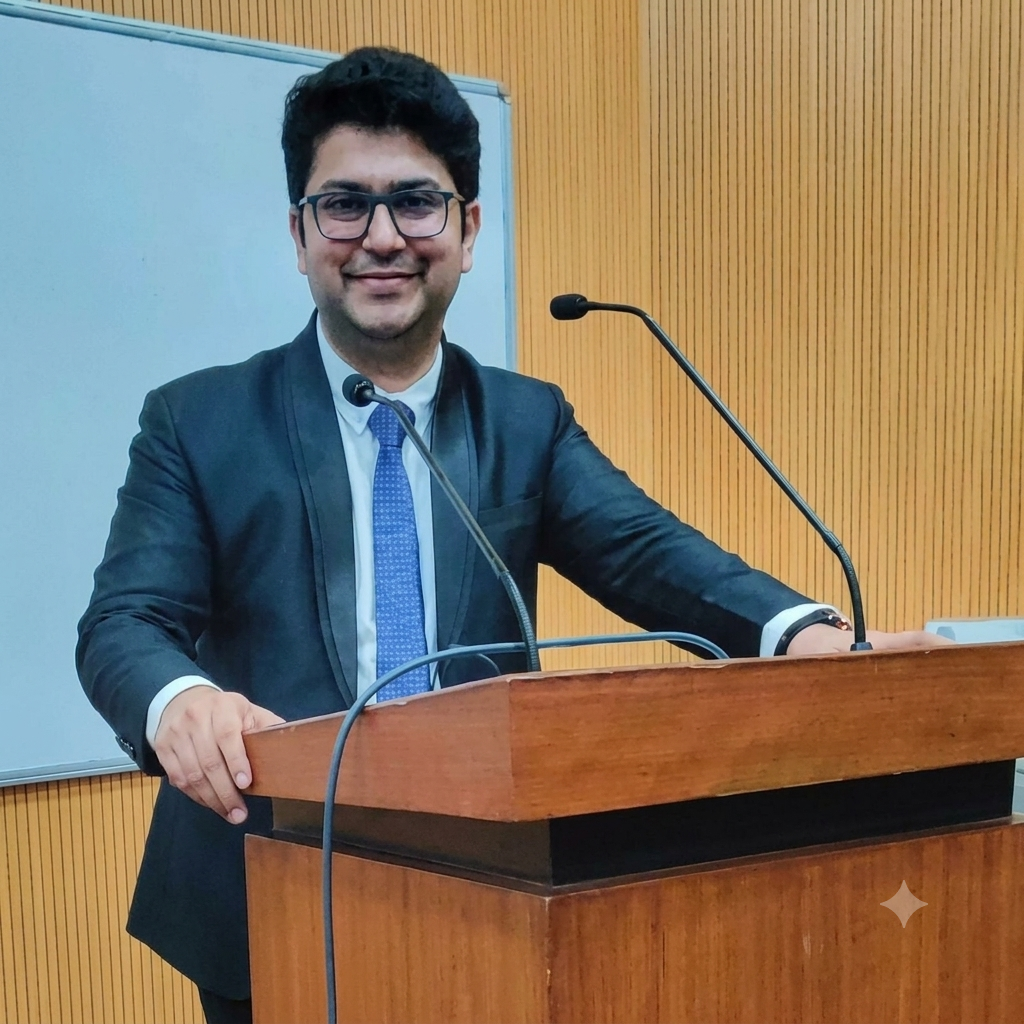
Sahil Pahwa
Cognizant
IIM- C Alumni | IIT R Alumni | RPA (UiPath) & Agentic AI Architect | Technical Project Management | UiPath Certified
Dr. Sumit Varshney
Thapar Institute of Engineering & Technology
Academician and Researcher- Looking for Problems. Experienced Researcher with a demonstrated history of working in the higher education industry.
Dr. Shubham Kumar Nigam
University of Birmingham Dubai
Postdoc Fellow @University of Birmingham || DaaD Postdoc-NeT-AI Fellow || Research Associate @BharatGen AI || PhD @IIT Kanpur
Kranti Kumar Parida
Samsung R&D Institute India - Bangalore
Chief Engineer at Samsung R&D Institute, Bangalore
Munender Varshney
Hitachi
Deep Learning, Computer Vision @ R & D center, Hitachi India
Badri Narayana Patro
Microsoft
Senior Research Scientist @Microsoft. Prev: Google, Microsoft, Samsung, Harman, L&T; @KU Leuven, @IITK, @IITB .
Vinay Kumar Verma
Amazon
Amazon | PhD IITK | Post-Doc Duke | Generative AI | LLM | Reasoning | Multi-Model | Computer Vision | In-Context Learning
Sahil Pahwa
Cognizant
IIM- C Alumni | IIT R Alumni | RPA (UiPath) & Agentic AI Architect | Technical Project Management | UiPath Certified
About the program
A systems-first program, not a tool tutorial
Most AI courses teach tools in isolation — a prompting week, a RAG week, an agents week that never speak to one another. The AI Systems Accelerator teaches the full stack as one connected system: intelligence, retrieval, reasoning and action, protocols, applications, automation, and evaluation, in that order, over twelve build weeks and a two-week capstone.
Every week ends in a live, defended demo. Every industrial project is reviewed by a panel against a fixed bar. By day ninety, you haven't just learned agents — you can explain, defend and extend every layer of the systems you've built.
Architecture before code
Every project starts with a design review, not a blank editor.
Panel-reviewed, not self-graded
Industrial projects and the capstone are defended in front of reviewers.
Evaluation as a discipline
A full week is dedicated to testing AI systems before trusting them.
Program design
Designed at the intersection of academic rigour and industry practice
Curriculum architecture led by IIT faculty
The system-design foundations, evaluation methodology and assessment rubrics were structured with computer science faculty from the IIT system, ensuring the program holds to the same rigour expected of a formal engineering curriculum — not a marketing-driven syllabus.
Delivered by engineers from top product companies
Build blocks, code reviews and demo-day panels are run by practitioners who have shipped AI systems inside FAANG and leading Indian product companies, translating what is actually asked of AI engineers on the job into every project brief.
Why this program
What separates this from a standard bootcamp curriculum
System design comes first, not last
Students think architecturally from day one, sketching a full component map before writing any AI logic — not prompting and hoping.
Protocols are core curriculum
MCP, A2A and ACP are taught as a dedicated week, exactly where the industry is moving, not treated as an afterthought.
Evaluation is a full week with a real deliverable
Most bootcamps skip this entirely. Here you build a golden dataset, an LLM-as-judge harness and a regression suite — the actual gap between a demo and production.
Agentic coding is taught as a skill
You learn to use AI coding agents deliberately — memory, sub-agents, parallel sessions — to multiply your own output, not just told to 'use Copilot.'
Every week ends in a live, defended demo
You graduate with a presentation muscle and a habit of defending technical decisions, not just a folder of finished code.
Voice, generative media and strategy, integrated
Bonus modules on voice agents, multimodal generation and product strategy run inside the 90-day timeline, not as separate courses that never get taken.
What you'll build
Fifteen shipped systems, across three months
Zero classical ML or data-science modelling. Every project is built on LLMs, retrieval and autonomous agents — the stack companies are hiring against today.
A grounded, retrieval-backed AI product
System architecture, a reliable LLM feature with failure handling designed in, a production-quality RAG pipeline, and an agent with real memory, tools and a protocol integration.
Industrial Project I — client-reviewed submission
MilestoneA launchable product combining system design, prompting discipline, RAG grounding and MCP-based tool integration, defended in front of a review panel.
A multi-agent system with an evaluation harness
Orchestrator/worker agent architectures, an eval suite with golden sets and regression tests, an agentic-coding-built feature, and a persistent automation assistant.
Industrial Project II — an autonomous AI system
MilestoneMultiple specialized agents, an automation and action layer wired into real tools, and an evaluation harness proving reliability, not just a demo.
A production-hardened capstone product
MilestoneGuardrails, observability, cost-aware model routing at scale, a specialization track of your choosing, and a full-stack agentic capstone defended before a hiring-style panel.
The stack
What you'll master, layer by layer
Every tool below is used hands-on inside a real project — not demonstrated once and left behind.
Intelligence & Reasoning
- OpenAI API
- Anthropic Claude API
- Google Gemini
- Groq / Ollama
Retrieval & Knowledge
- Qdrant
- pgvector
- LlamaIndex
- LangChain
Agent Orchestration
- LangGraph
- CrewAI
- OpenAI Agents SDK
Protocols
- Model Context Protocol
- Agent-to-Agent
- ACP
Application Layer
- Next.js
- FastAPI
- Streamlit
Automation & Action
- n8n
- Slack API
- Google Workspace API
Evaluation & Reliability
- Promptfoo
- Ragas / DeepEval
- Pytest
- LangSmith
Agentic Engineering & Infra
- Claude Code
- Docker
- GitHub Actions
- Redis
Who should apply
Built for four kinds of applicants
Final-year & recent engineering graduates
You know how to code but every job listing now asks for agent and RAG experience you haven't had a structured way to build.
Working software engineers
You want to move into AI-systems work without quitting your job for a two-year degree or a vague self-taught path.
Product & early-stage founders
You need to understand what's actually feasible to build with today's models, tools and protocols before you commit a roadmap to it.
Career-switchers from data & analytics
You have technical fundamentals and want a direct, project-based route into AI product and agent engineering roles.
Outcomes
Roles you'll be ready for
Backed by a portfolio of fifteen deployed systems, three panel-reviewed industrial projects, and three dated internship letters.
From past cohorts
What graduates say about the program
The evaluation-harness week alone was worth the program. Every other course I'd looked at treated testing AI systems as an afterthought — here it was a full deliverable with a real before/after report.
Ananya R.
AI Product Engineer, Bengaluru
I came in with backend experience and no ML background. By week five I had shipped a RAG product a client actually reviewed. The architecture-first approach made everything after it click.
Karthik S.
Software Engineer → AI Agent Engineer
What stood out was the protocol work — MCP and A2A aren't taught anywhere else at this depth. Two of my interview loops asked about exactly this, almost verbatim.
Meera V.
Forward-Deployed Engineer, Hyderabad
Review the full 90-day curriculum
See the day-by-day breakdown, every tool used, and the exact bar each of the three panel-reviewed projects is held to, before you apply.
Frequently asked
Questions before you apply
Can't find what you're looking for? The full curriculum PDF covers every week in detail.
No. The program is built entirely on LLMs, retrieval and agents — the stack companies are actually hiring against today. Classical ML, statistics-heavy modelling and data-science fundamentals are not part of the curriculum.
Build-days run roughly six to seven hours: a concept sprint, a build block, a standup and a short systems-thinking drill. The program is designed to be completed full-time over 90 days, with every week ending in a live, defended demo.
Each of the two Industrial Projects and the Capstone is reviewed by a panel against a fixed bar. Submissions that clear it earn a dated internship letter (AI Product Engineer Intern, AI Agent Engineer Intern, and AI Full-Stack / Forward-Deployed Engineer Intern) that you can list on your résumé and LinkedIn.
Yes. You leave with fifteen deployed systems, three panel-reviewed industrial projects, a documented evaluation harness, and a portfolio of case studies — not slide decks or toy notebooks.
Cohort-based. Every build-day includes a public standup and a live demo day, and every project is reviewed against a fixed panel bar rather than graded individually and privately.
Each industrial sprint and the capstone include buffer days built into the schedule specifically for this. Mentors also run office hours through every build block.